Today, I totalled 8.6 km in long distance swimming, accumulated over 5 days of swimming, with each pool session lasting for 50 mins.
What this distance really means depends on where I started. Every exploration moves from A to B. To understand B, we need to know A.
So, Where am I coming from ?
The Newness
Two years ago, I started learning to swim in a pool. It felt nice on my body, but also very different. It’s an entirely different form of movement from walking and running on land, where you are upright and look straight ahead. In freestyle swimming, you lie flat on your belly, with your head almost submerged, looking at the pool floor while your body moves forward.
In the first few months, I learned the basic techniques of breathing, floating, and movement in water. It felt similar to learning to ride a bicycle, only a little more complex.
The coaches at the pool helped me learn the basic techniques of kicking, breathing and hand movements. Soon, I got promoted to the 25-metre section of the pool, where swimmers could go back and forth to practise.
Figuring it Out: The Physics of Swimming
These months felt like good progress. Since I teach physics, I was aware of the forces of buoyancy, drag and the lift force a body experiences when it passes through a liquid at speed (Bernoulli’s principle). But what did it mean for my own body in water? That’s what intrigued me.
I started with buoyancy and could see that if I lay flat on the water, I could float for the first few seconds, but then my legs started to sink. Meanwhile, a friend of mine, Dhruv, could simply lie flat on the water without doing anything, not even kicking. So, different bodies float differently in water. They remain afloat if the lungs have air, but the position in which they float varies. For me, I needed to kick a bit if I wanted to stay flat on the water.
Then I found out that Bernoulli’s principle, or the lift force, actually works in water. When I was swimming with some speed, the streamlined flow of water around me kept my body straight and prevented my legs from sinking. This was good news, as while moving I didn’t have to worry much about becoming upright.
The third one was drag. It turned out to be the trickiest and the most interesting one to decipher. My own understanding suggested that the straighter and thinner the body remained as it moved through water, the less drag it would experience.
I was naturally drawn to reduce drag, partly because it felt like an interesting physics problem, and partly because I imagined myself more in long distance swimming than in sprint. So, reducing drag could mean swimming more efficiently and saving more energy for longer distances.
To start with, I reduced my kicking rate to a bare minimum. It felt like a tradeoff. Flutter kicks propel the body forward and provide speed, but they also consume more energy and, if too wide, can act like breaks. The wider the kick, the greater the drag.
Since I was focused on reducing drag, I went ahead with minimal kicks. I did this quietly, hoping the coaches wouldn’t notice, because at the time they preferred vigorous kicking.
Soon, I was swimming in a way that almost felt like gliding through the water. One stroke, then a small glide. Another stroke then another glide, with only a kick or two in between.
More Problems to Solve
The quick progress that I felt in the previous months began to taper off. New problems emerged. This period felt like incremental problem solving, one problem at a time.
Among the first problem was “unable to see yourself”. On land, in almost every movement we make, we can watch what we are doing. But in the water, lying flat with my face mostly down, I couldn’t see how my hands and legs were actually moving.
In my mind, I was streamlined, but in reality my body might have been hanging in the water.
So I started listening instead. I realised that sound, rather than sight, could be better sense in water. If there was less splash from the hands and legs moving, and all I could hear was the sound of air bubbles leaving my nose, then the streamline was probably going well.
Soon I started listening to my own movement through the water and tried to make it quieter. Eventually, only the sound of exhaled air bubbles remained audible, everything else became silent.
One day, I remember, I swam so quietly that Dhruv and I later joked that I had started swimming like a crocodile.
During this time, I started making notes of what I had learned during each swimming session, just after coming out of the pool. I would write how the gliding technique could be improved further and leave myself some instructions or pointers to look before the next day’s session.
It felt fun, as if I was building something. The water felt like a laboratory where I could test, in real time, what actually worked. Something started to emerge from my experience. As I began to feel that there is a new gliding technique I had stumbled upon, than the one I had been practicing until then.
Earlier, it felt like I pushed the water with one hand, generated propulsion, and then glided while keeping my body streamline. But what I was now beginning to feel in the water was different. Rather than treating the hand as something that pushed the water behind me, I could treat it as a hinge around which the rest of my body moved forward.
I visualised it like this: imagine big blocks floating in space while you try to move past them by pushing against them. As you put your hand to press against them, the blocks hardly moves as they are so massive. But your own body moves forward instead. During this the hand in contact with block almost stays still like a hinge and it’s the body that goes ahead gliding.
I tried to switch to this “water-as-a-hinge” technique rather than the idea of simply pushing the water backwards. Usually, after half an hour or so into the session, I could feel my body cooperating with my idea in mind and I could feel it happening. My hand strokes slowed down, while my body seemed to use them as hinges to glide through the water.
It felt fun as I was more present in water, and was learning something new on my own. Looking back now, I realise this wasn’t the physics that I had learned through teaching. It emerged out of my experience in water, and only later I found the concepts to make sense of it.
I also realised something counterintuitive about drag. If I came out of pool tired in my muscles, then it was probably not that I swam farther and better. It could simply mean that I fought with water more, and the drag had been higher. Greater resistance and pressure felt in muscles seemed to indicates greater drag. While when the body was better streamlined then it moved with relative ease across water, and after coming out of water the fatigue felt less.
This made swimming feel different from running, where putting more effort means tiredness in muscles. While in swimming, however, greater effort spent staying streamlined could actually mean feeling less fatigued after the session.
This is still only a personal observation, not a conclusion, but it made me realise that swimming isn’t as straightforward as running.
More nuanced problems came up, as I tried to refine the gliding technique. It felt like a good problem solving, with no clear answers to begin with, just hit and trials and experience to learn from.
During this time, I came across a swimming speed competition. I was not practicing for speed swimming, but I wanted to give it a try and see what happened.
It Isn’t Working
The competition exposed my swim timings as only average. It took me some courage to reach out to the coach and ask him to time me. Both of us were surprised with the timings, and not in a good way. With the amount of time I was spending in the pool, I was slow.
Suddenly, my technique came into question and it actually appeared to be the opposite of sprint technique. The coach wanted faster hand movements, more kicks and fewer breaths between strokes. “Splashing is fine, why are you gliding so much ?”
I had expected if my gliding was efficient, I would be faster in water. But it didn’t work as I had expected, as I could see the coach’s approach working for others.
It was discouraging, as all my efforts so far didn’t seem to add up. I learned something, but it didn’t seem to align with swimming fast. I felt short of ideas.
As the competition was approaching, I thought of making some adjustments for speed. I stopped trying to be too streamline and instead increased my stroke rate and tried skipping breaths. There was more splash in water, but those were the adjustments I made. The timings did improved a bit, but I wasn’t enjoying it, as it felt like a compromise on both speed and smoothness of my swimming technique.
But then I developed an ear infection just before the competition, so I couldn’t participate. I had several such infections during the monsoon swimming season, until I learned to dry my ears using a hair dryer after swim sessions. Using a hair dryer felt bit odd in men’s washroom, but my ears liked it.
After this discouragement, I was left feeling directionless. What was I even doing?
I tried to continue with my smooth swimming technique, but I had lost my old rhythm. I then shifted my focus to some new problems, like trying to become more comfortable in water, especially around breathing, and learning to feel less panic around it.
But this feeling of stagnation and aimlessness started to grow on me. So, I took a break for a few months before resuming swimming again.
The Elephant in the Room
After the pause, I resumed swimming, as it had become good part of the day where I could simply get into the water and live my life, leaving everything else behind.
To keep things simple for myself, I thought I should address the elephant in the room first.
The elephant: I wasn’t swimming continuously.
I decided to work on this before worrying about technique.
This felt like a big challenge, as I had developed the habit of stopping after a few laps and hanging onto the wall for a break to catch my breath. My maximum continuous swim, with my best effort then, was 200 metres. Most of the swimmers around me faced a similar situation.
To solve this, I saw the problem as: I am not comfortable breathing continuously in water for an extended period.
So, the solution I came up with was a simple rule: Holding the wall between laps was fine, but every exhale had to happen underwater.
Even if I am taking a break on a wall, I would keep dipping my head into the water to exhale.
This felt like a manageable approach, as the support of wall was still there, while I was slowly making myself more comfortable with continuous breathing in water.
This started to work. I crossed a mental barrier of swimming 400-500 meters without stopping. Even then, it felt like a one off achievement, and I was still learning to become comfortable in the water.
Support of the Wall
One day, I was sitting at the end of the pool and the session was about to start. I had the thought of trying to swim diagonally towards an opposite end. The pool was empty, so I wouldn’t collide with anyone.
As soon as the bell rang, I started to swim. The diagonal distance was around 40-50 metres compared to the usual 25 metre lap. I could swim the whole distance with relative ease. With the longer distance, I found that I could wait for the wall to arrive and remain calm the entire way.
Although this may not seem significant in terms of distance, but to me it was an eye opener. My mindset came into question.
I had trained myself to think of a 25 meter lap as one complete effort. I naturally felt tired afterwards, as if I had completed an obstacle, and felt like taking a break. But now, with increased distance, I still could remain calm throughout and only looked for a break after reaching the wall.
I realised that the wall gave me psychological safety of land amid the otherwise uncertain feeling of being in the water.
This left me thinking about the possibilities I could explore if I could work on this aspect.
That feeling grew stronger with time, as I found myself repeating while swimming “I belong here”.
It was like I would take a stroke in water and let the outstretched hand go a little deeper, touching this unknown space and staying there for a brief moment, as if I belonged there, before pulling back and propelling my body forward. With each stroke my hands reached for the unknown, to touch it and stay with it longer.
My dependence on wall began to reduce, although it was still there. I was not minding taking small pauses amid these “I belong here” laps.
The Distance Swimming Challenge
During this time, I came across a new competition that was going to start soon after a month. One had to swim maximum possible distance on five different days over a period of ten days, and there was no time limit for an individual session.
I felt interested in it, as distance swimming is what I had in my mind since the beginning. But, then I wondered whether I would be prepared enough to do it within a month.
I didn’t know how far I had been swimming at that point. My guess was that it was still under 1 km. But since time wasn’t an issue, I thought I could simply increase my distance by taking short pauses at the wall. I believed my endurance was good or it would improve with practice.
I first crossed 1 km in a session, then reached 1.5 km in another, and finally crossed 2 km in 1 hr 20 mins. But I developed a cramp in the calf muscle of right leg from staying in water for so long. It was more painful than I expected and took a few days to recover. There were about 15 more days left before the competition.
I discussed my progress with the coach. He was of the opinion that I could target 7-8 km in the competition, and that it would be a good number to aim for. But then came a new surprise, there was a 50 min time limit of for each individual session.
I was caught by surprise. I had been expecting there to be no time limit. It seemed that coach had also been unaware of this rule earlier, and that it had been added later.
This changed things for me. I could feel my confidence shrinking around aiming for 7-8 kms. Those distances had seemed possible when there was no time limits, but now it was hard to imagine what I could do within a 50 min session.
Until then, I had never actually swum continuously for 50 mins, there had always been short breaks at the walls. My longest swim had been 2 km in 1 hr 20 mins, essentially 100 mins. Adjusting that to 50 mins, meant about 1 km in a session, bringing the cumulative distance over 5 sessions down to only 5 kms. Going beyond that would mean almost eliminating breaks at the wall. That thought felt like such a mental uphill climb that I couldn’t see beyond it.
There was also the additional concern of developing a cramp again in middle of a swim, especially if I pushed harder. It would be very embarrassing to be rescued from pool during the competition, and, I imagined, demoralising for the other participants as well. I felt that if such a situation arose, I should at least be able to carry myself out for my own self respect.
At this point, my calf muscles were still giving the occasional twinge of tension.
Finally, it also felt challenging to produce my best swim on almost 5 consecutive days. I had plans to go out of the city for some time, so I wanted to finish the competition within five or six days.
With some disheartenment, I had to let go of 8 km target and settle mentally for 5 km instead. The 8 Km line felt like a distant dream, perhaps for another time. For now, I had to content myself with trying to cross 5 km instead.
Gearing Up
I could manage one more day of swimming before the competition started. So, I tried swimming as continuously as possible for 50 mins, without pausing at the wall. To my discouragement, I somehow managed to reach only 1 km. My mind was frustrated and complaining, like why I am even doing this? and how demoralising will it be if I can’t even cross 1 km in a single session ?
Then another surprise came, but this one felt like an opportunity. I reached two days before the actual start of the competition, thinking that it began that day. The date had been shifted, but I hadn’t received the update. When the coach told me that I was early, I didn’t feel like complaining, and thought that maybe I could use the day to improve my distance.
When I came out of the pool, I almost reached 1.4 km. It was my best effort until then, and I began to feel hopeful that crossing 5 km line might actually be possible.
It Begins !
First session
The competition started on a weekend. I arrived after a good night’s sleep, and proper hydration hoping to avoid cramps.
While taking a shower, I realised I wasn’t making any plans for the coming 50 mins. This was unusual. As most of the times before an event say while running, I usually have a plan. Something like: I will start slow and then after certain time or distance, I will increase my pace.
But this time I had this inner sense towards having no plan. Still, out of my habit to plan, I came out with a minimal plan: try to cross 1 km in 50 mins.
My lane was completely empty when I entered the pool. The coach sat on the chair beside the lane, to count my laps. It felt nice to have an exclusive lane and the coaches full attention.
I started with moderate effort, completed one lap and pushed off the wall for the second, while the coach counted the first lap. Then the laps kept coming.
At some point I felt the urge to look at my watch, and check the time and distance covered. I looked and saw that about 20 mins had passed, and I hadn’t covered much distance.
Here, something happened that I still can’t fully comprehend, but I will try to express it as close to real as possible.
As I looked the watch, instead of the usual feeling of dissatisfaction, I felt like letting go of it altogether. It was as if I wanted to get rid of everything occupying my mind, including the watch, the competition, the distance and the time. I didn’t want to “think” anymore.
With a breath, I pushed off the wall and started swimming again.
It felt like there was an invisible mental line, which I mumbled to myself as “time- distance line”. Everything I knew existed within it, including my motivation to swim, what I wanted to achieve and my current performance. Beyond that line, I had no idea what was there.
I spoke to myself that I was going beyond this time-distance line, and just swam past it.
My mind was calm, and now I only wanted to stay in water until the bell rang. Stroke by stroke, I was there, swimming. It is difficult to recall fully what I felt into those moments, except that I was present there.
Finally the bell rang, I was exhausted, and the coach confirmed the distance as 1584 m. I was happy. The coach was happy. But, I was also left surprised.
The swim wasn’t marked by trying to chase a number, but by swimming away from everything familiar. But towards what ?
Second Session
This happened the very next day. I was tired from the previous day’s swim, and was skeptical about whether I should swim again or wait another day to recover. But I had plans to go out of the city after few days, so I had to finish the competition soon.
I went for the swim at the same time of the day. There was no new plan. Just me and the water.
The same coaches were there to count the laps. I got into water again and could feel the tiredness in my hands from the previous day. But I kept swimming, and I felt that my body had switched back to gliding.
Somehow, the smooth gliding technique I practiced for months, retuned with some modifications and a better stroke rate. But the feeling of gliding in water, streamlined and with less effort remained the same. It greatly saved my energy, which was already low, and allowed me to spend it more economically.
When the bell finally rang, the coaches looked surprised. The new distance 1672 m, was better than the previous day’s. It was unbelievable to them that I had improved when they had expected me to either maintain or reduce my distance.
I was happy to see them being surprised, but I remember saying, “I feel very very exhausted.”
One of the coaches smiled and replied, “You will be after this swim!”
Third Session
Again, this was the next consecutive day, but this time in evening instead of morning. I had replenished my energy, and hydrated well. Somehow, the electrolytes seemed to be helping, as I hadn’t developed a cramp so far.
This time, there were more people in the same lane, and I had to swim alongside them. I started faster, completing the laps a little quicker than before, perhaps because I was getting accustomed to the 50 mins format.
I remember seeing the watch frequently, and I reached the 1 km mark soon. I was happy, but now I started to feel tired too. So, I began taking few pauses at the wall, and my pace also dropped a bit.
Then I had to let go of following time and distance , and once again I swam past that mindset into a quietly exploratory state, where I swam at whatever slow pace I can till the bell rang.
There was a girl who was also swimming with similar pace as mine. She let me pass while she paused at the wall to conserve some of her energy. I found her quiet considerate, especially when everyone around us, including me, was absorbed in their own swim. Maybe she could see me struggling in the water, trying to cross an imagined line that no one else could see.
The bell rang, and the coach said, 1716 metres, and that I had put fire on the water today. I was tired, a little surprised. I thanked the girl, then took shower, and returned home. Nothing much went into my head.
I called Dhruv later in evening, and told him that everyday I came back feeling that I couldn’t possibly swim the same distance tomorrow. It always felt as though I had given everything I had and would not be able to repeat it.
Yet the next day, I would get surprised as the distance improves. He laughed and said, maybe that’s exactly the feeling you need to improve the next day.
Fourth Session
This time, I took a break of a day. I again came out with few self instructions to follow, like when stress hits, the body tries to contract, as if wanting to stand upright in water, but I would keep trying to stay relaxed and streamlined.
As the bell rang, I started strong again, but it first 20-30 mins felt heavy, and I couldn’t even maintain a good pace. I felt as though I was struggling.
I took a pause and decided not to worry about self imposed instructions anymore. Instead, I went back to the basics, which was just swim and try to stay in water a little longer.
The bell rang, and I did 1760 meters, better than before but the level of exhaustion was too much. It felt hard on body.
I remember saying to myself that, I have already come beyond what I had initially imagined. Let’s accept this as my best distance, and tomorrow, for the last swim, let’s do it with no instructions. And enjoy our swim as much as possible.
Fifth Session
This day was all about exploration, with no time to watch and nothing to worry about. The touch of the water and the joy of playing with it were all that I wanted.
The bell rang, and there were four or five swimmers in the same lane. The same girl from session 3, was also there, and she seemed determined to push herself harder.
The swim began, and I went gliding into the water, swimming past that imagined time- distance line, and I simply kept swimming. I felt my pace was moderate, as it didn’t feel hard on body. And I kept swimming without trying to push harder.
As far as I can remember now, I enjoyed my swim. I did try to increase the pace a bit towards the end, but only when it felt natural to my body, and not like an effort.
Lap, after lap, pushing the wall, and then taking the strokes without any rush, and continuing until the bell finally rang.
The distance covered was 1892 metres, and I didn’t feel exhausted. I was happy to have crossed 1800 metre mark, and the coach was also very happy.
The same girl had also improved her distance, though she said she felt completely exhausted.
Beyond the 8 km line
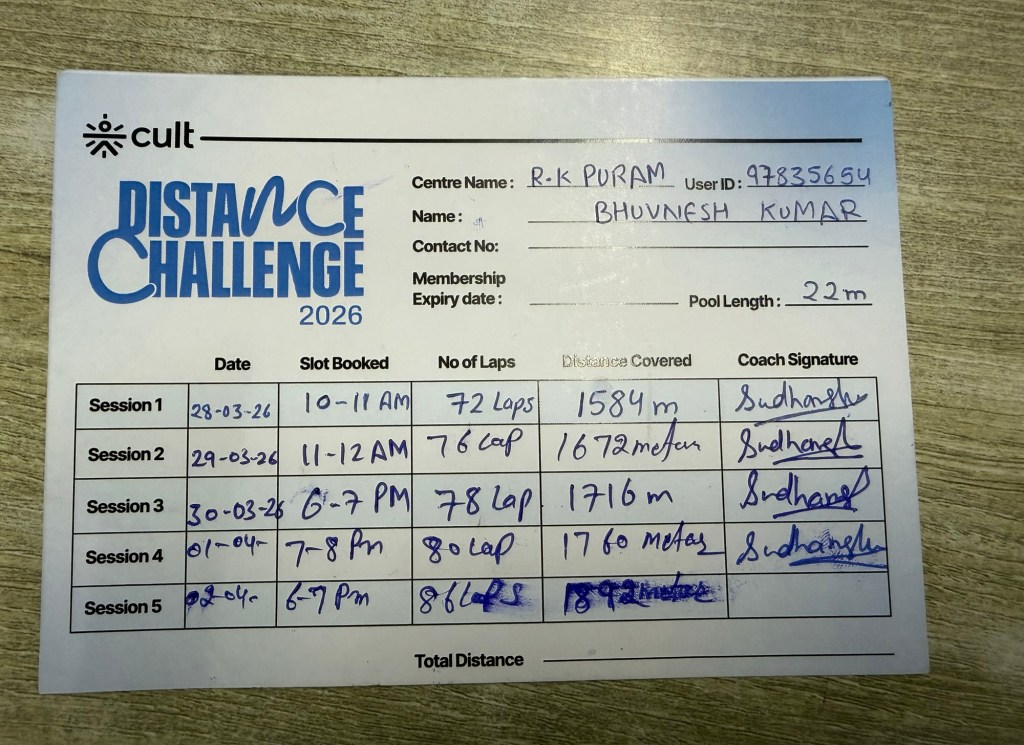
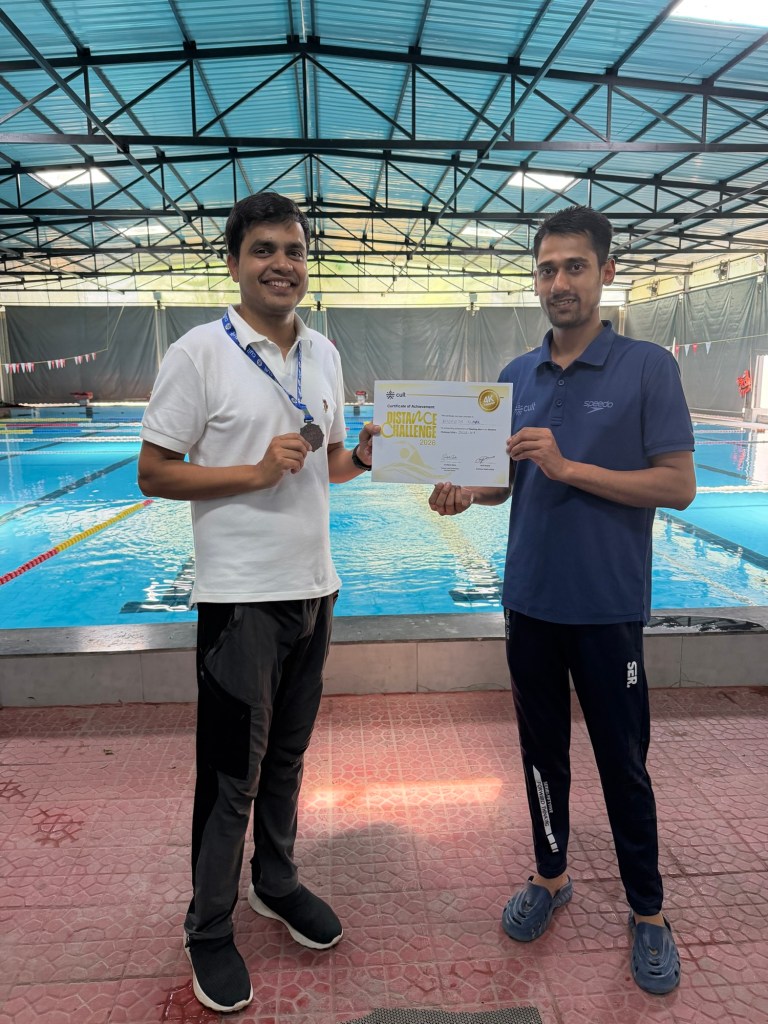
The competition was finally over for me, and when I totalled the distance, I had not only crossed 8 km but had gone beyond it to 8.6 km.
It was a kind of happy disbelief. The part of me that had been complaining before, asking “why am I even participating in this competition ?” , went silent. It simply didn’t know what to think.
I felt as though my understanding of myself had come into question. I had often judge myself whether I was capable of something based on what I thought I could or couldn’t do.
But here I could go beyond my imagined mental limits, by simply swimming and, at some point leaving all my concerns behind. The experience of swimming and the touch of water took the front seat in those moments.
The preceding months, which had felt like stagnation with no visible growth, did help me. By silently adding up the temperament to stay in water even when efforts didn’t seem to add up.
Staying then, helped me stay longer with uncertainty during the competition.
After Thoughts
Question of self image
It has been two months since the competition, when I am finally able to put these thoughts, and express my emotions surrounding them into words.
There is something that continues to linger in my mind and urges me to understand it clearly. Those moments when I crossed the time-distance line felt as though I had crossed the limit of my own comprehension.
My mind is usually curious and doesn’t let go of its thinking threads easily. But in those moments, a different and more assured sense within me took over, as my mind gave way and allowed itself to swim beyond its limits of comprehension. It was a choice that my mind somehow agreed to.
A similar event happened years back, during my first trek to Churdhar. The constant fear of encountering a bear during the night trek eventually forced me to stop thinking, as my mind could no longer sustain the fear. It felt like a fear fatigue. Then, it was more out of exhaustion than a choice.
But, what feels common to both experiences is that my mind or cognition gave way to a more assured sense of life, and the moments that unfolded happened beyond limits of what I had previously known.
After the swimming competition, I found it difficult to understand and catch up with the experience. Before it, I had a complaining self asking why I had even registered, convinced that it would be demotivating if I don’t perform well.
But, after the competition when I sat with it and asked how it felt now. It didn’t know what to say.
So, while writing the blog, when I reached the point where I crossed the time-distance line, and tried to express what I had felt in those moments, I could still sense a gap, almost like an uphill climb.
It felt as though my old self was standing at the entrance of a tunnel, sloping upwards and it has to swim upwards through it. It’s hesitant. On the other side of the tunnel, my present self awaits with a smile, encouraging the old one to come up and join it.
As I tried to express, and when I found the right words or expressions, it felt as though my old self slowly managed to swim upward through the tunnel.
And, when I finally finish writing this piece, it felt as though my old self had almost caught up with the present one.
Curiosity and the Unknown
About that hesitant old self, I have this feeling that the unknown is the real part of our lives. Most of the time, it remains hidden beneath familiarity, beliefs and our willingness to ignore it. But sometimes it becomes alive and unavoidable. Like the bear on Churdhar.
In those moments, the mind feels exposed. The situation has become larger than what it can perceive or answer. The mind likes certainty, yet it finds it difficult to acknowledge the unknown, and even more difficult to make peace with it.
In swimming, the unknown was the space of possibilities, while the known was the certainty of not doing well. But the unknown became alive during the actual swim.
Only when the mind stops trying to answer the unknown and accepts that it is here to stay does it begin to find peace.
Possibly the growth of mind lies in acknowledging that the unknown is real part of life, rather than trying to hide from it. While the unknown is often uncomfortable, it’s perhaps necessary for us to feel alive.


Leave a Reply